Will Not Start
You press Start and nothing at all happens, with a full load already waiting inside.
A washing machine works only with its door closed and locked, and a door that shuts properly makes a click. So when the lights come on but no wash starts, sometimes a piece of clothing caught in the door keeps it from locking. When nothing is in the way and the lock itself has failed, we carry out a door lock replacement.
A control panel that stays dark, with no lights at all, means no electricity is reaching the controls. The power comes in through the cable to the control board (PCB), the board behind the buttons. So we test both with a meter and replace the one that fails its test. Your machine then powers up and starts the wash.
Not Filling
The water comes into your machine very slowly, or the drum stays empty with your clothes in it.
A kink, a sharp bend in the inlet hose from the tap, slows the water supply down or stops it, even with the tap fully open. So does a blocked mesh filter, the small filter where the hose joins the machine, and on an LG either one can bring up the IE code for a water inlet fault. Our technician straightens the hose or cleans the filter.
The water inlet valve lets the water into the drum, and when this valve has failed, no water gets in at all, so we fit a new valve. The drum then fills at full flow on every wash.
Not Heating
Your work shirts come out of a hot wash with the grease still on them, because the water is not getting hot enough. Clothes that feel cold at the end are no sign of this fault, because the last rinse of a wash is usually cold.
Limescale, the hard white crust you also see in a kettle, slowly coats the heater that warms the water and slows the heating down until we descale it. But the water also stays cold when the heater has failed or the temperature sensor, which tells the machine how hot the water is, goes faulty. The two look alike from the outside, so a meter tells them apart, and we fit a new heater or sensor only where the meter finds the fault.
Cycle Stops Midway
Has your washer stopped in the middle of the cycle, with the soapy clothes still inside?
A short pause is not always a fault, because thick foam from too much detergent stops the machine for a short while so that the foam can go down. This can happen several times in one cycle. When foam stays behind in the detergent drawer, the pump and the hoses, our technician flushes it out.
The cycle also stops when the water level sensor, which checks how high the water stands in the drum, or the motor that turns the drum fails. We replace the sensor, or we repair or replace the motor, and the wash runs on to the end.
Not Draining
The cycle ends, but dirty water stays in the drum, with your clean clothes sitting in it.
The water leaves the drum through the drain filter, which usually sits behind a small cover low on the front panel. When lint, the fluff that comes off clothes, blocks this filter, the water stays in the drum, so we clear the filter. Then the drain hose carries the water away, and a kink in it holds the water back too, so we straighten it.
The drain pump sits between the filter and the hose and pushes the water out, so once the filter and the hose are clear, the pump can do its job again. We replace the pump only when the pump itself has failed.
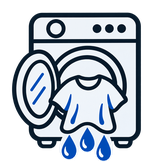
Not Spinning
The spin wrings the water out of your clothes, so when the spin fails, the clothes come out heavy and soaking wet. You are left to hang them on the rack still dripping, and there they take much longer to dry.
Sometimes it is only that heavy things such as towels or bedding have bunched up on one side. An unbalanced load like this turns the drum lopsided and makes it shake hard, which is why the machine slows the spin down or stops it to protect itself. No part has failed then. The machine usually spins normally again once the clothes are spread evenly around the drum. A towel or two beside a single heavy item helps to balance the drum. The machine also slows the spin down when something blocks the drain, and our technician clears the blockage.
When the drum still does not spin after that, a part has failed. Belt-driven models turn the drum through a belt that the motor drives. When this belt snaps or comes off, the drum stops, but you may still hear the motor running. Our technician carries out a drum belt replacement. When the motor itself is faulty, the drum stops as well, and a motor repair brings back the full spin.
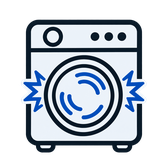
Loud On Spin
When the spin makes a rattle, a scrape or a rumble, the sound tells our technician where to look.
Coins and hair clips left in pockets can slip out of the drum into the outer tub that it turns inside. Our technician takes them out, so they no longer rattle or scrape in that tub on every spin. A rumble usually comes from worn drum bearings, the parts that let the drum turn smoothly. We then fit new bearings, or a new tub on models that have the bearings sealed inside it.
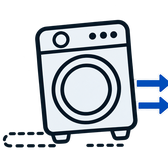
Shaking Or Moving
The whole machine shakes on the spin, moves across your floor and knocks the cabinets beside it.
A new washing machine comes with transit bolts at the back, which hold the drum still on the way to your home. When these bolts stay in after delivery, the machine shakes and moves on the spin, so we take them out. The machine also stands on adjustable feet, and uneven ones make it rock and move too, so we level them.
Worn shock absorbers are the third cause, because they can no longer hold the drum steady on the spin. The drum then bounces and bangs loudly against the sides of the machine until our technician fits new ones.
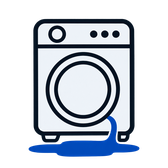
Leaking Water
Is your leaky washer leaving water on the floor with every wash? A puddle at the front may mean a damaged door seal, the rubber ring around the door, which our technician replaces.
Water that collects underneath often comes from inside the machine. A cracked hose needs replacing and a leaking drain pump needs a pump repair, while a loose joint where a hose connects only needs tightening.
Door Will Not Open
You pull the handle and the door stays locked, with your wet clothes shut inside.
The lock holds the door shut on purpose while the machine is hot, the drum is turning or water is left in the drum. That is why a blocked drain filter, which holds the water in, keeps the door shut as well until we unblock it.
When the lock itself is faulty, our technician fits a new lock, so that the door opens and locks as it should.
Bad Smell
Your clean clothes come out of the wash with a damp, musty smell, which they pick up inside the washing machine.
The smell is mould, growing on the detergent and softener left behind in the door seal and the drawer, where the water never quite dries out. Our specialists clean the seal, the drawer and the drum to remove the leftover detergent that feeds the mould.
Error Code Showing
Clothes are stuck in the washing machine because of the error code shown on your display screen, and the washing machine stops working.
Error codes point to the area of the machine where the problem is. But every brand has its own set of codes. OE on an LG means a drain fault. The same OE on a Samsung means an overflow, with too much water in the drum.
The code does not name the exact part, though, because a drain fault can come from the filter, the hose or the pump. Our repair experts read the code, test each part in that area and repair the one at fault.